
Tavus Griffin AI is a real-time video conversation system that listens, watches, speaks, and generates an expressive on-screen person. Tavus calls it a Human Interaction Model (HIM). Its October 1, 2026 announcement attracted attention with a striking claim: Griffin is the first model to pass the video Turing test.
The number behind that headline is 26 out of 54 participants, or about 48%, who believed they had spoken to a real person after a one-minute video call in Tavus's study. As of October 2, Griffin-Lite is a limited research preview for selected testers, rather than a public tool anyone can open and use. Here is what the model does, what the experiment establishes, and where to see the demos.
What is a Human Interaction Model?
Human Interaction Model is Tavus's name for a model designed around live, face-to-face interaction. The job includes understanding a person's speech and visual context, deciding when to respond, and producing speech, expressions, and gestures together. Tavus presents Griffin as the first model in this category in its official research breakdown.
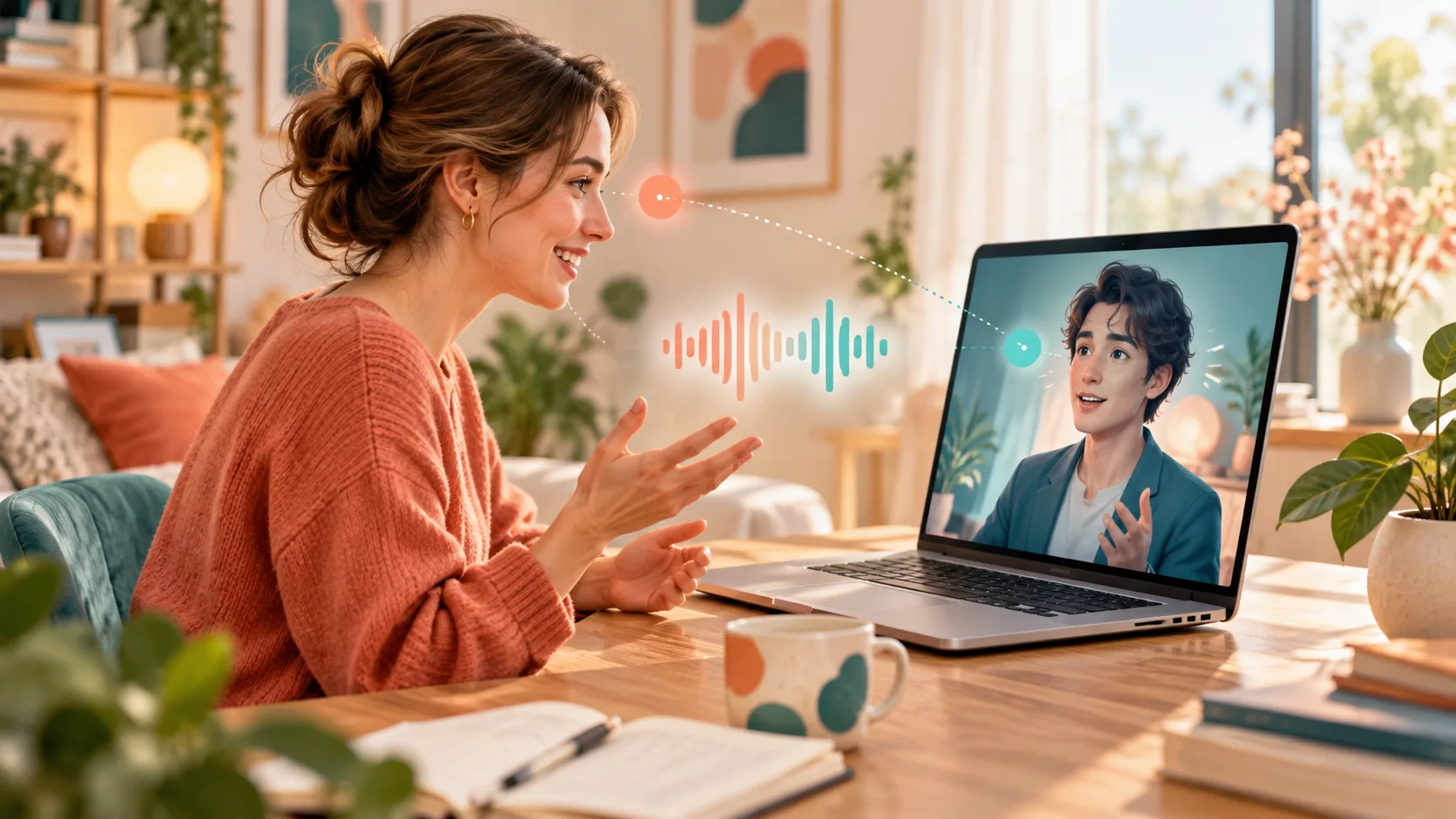
Imagine telling an AI about a frustrating day. A natural conversation involves more than a correct sentence after you stop talking: the other person might nod while listening, adjust their expression, or wait when you pause to think. Griffin is designed to coordinate those behaviors as the exchange unfolds.
This is the meaning of full-duplex video conversation: incoming audio and video continue to inform the response while the system is speaking. In Tavus's description, Griffin can acknowledge a speaker, handle interruptions, and change what it says in response to something it sees mid-conversation.
The phrase HIM describes Tavus's proposed category. It should not be read as a guarantee that a model understands people perfectly, or that realistic expressions imply human feelings.
How is Griffin different from an AI video generator?
A finished video and a live interaction solve different tasks. If you want a clip for a social post, you typically specify the scene, generate it, and download the result. A live video conversation has to keep responding to what you say and show.
| Type of tool | What you provide | What you receive |
|---|---|---|
| AI video generator | A prompt or reference image | A finished clip to review and share |
| Scripted talking avatar | A script or recorded speech | A presenter video delivering prepared content |
| Griffin's live interaction system | Ongoing speech and camera input | A video counterpart responding during the conversation |
Tavus says Griffin generates the full scene from a reference image, including gestures and background movement, rather than animating only a face. That distinction matters when someone raises a hand, leans back, or responds to an object held up to the camera.
What does “pass the video Turing test” mean?
In this announcement, the video Turing test refers to Tavus's live-call experiment, where participants judged whether their conversation partner was a person. The protocol is essential to interpreting the result:
- Participants were recruited through an independent research platform and told they would speak with another participant.
- They had a one-minute video call about what they were looking forward to that year. Their partner was actually an AI powered by Griffin-Lite.
- Questions after the call explored the conversation and whether the partner might not have been human. Participants were then informed that the partner was AI.
Tavus reports that 26 of 54 Griffin-Lite participants believed their partner was human. In a separate run using its previous Phoenix-4.5, Sparrow-2, and Raven-1 system, 1 of 41 did. These figures and the methodology are published in the face-to-face study section.
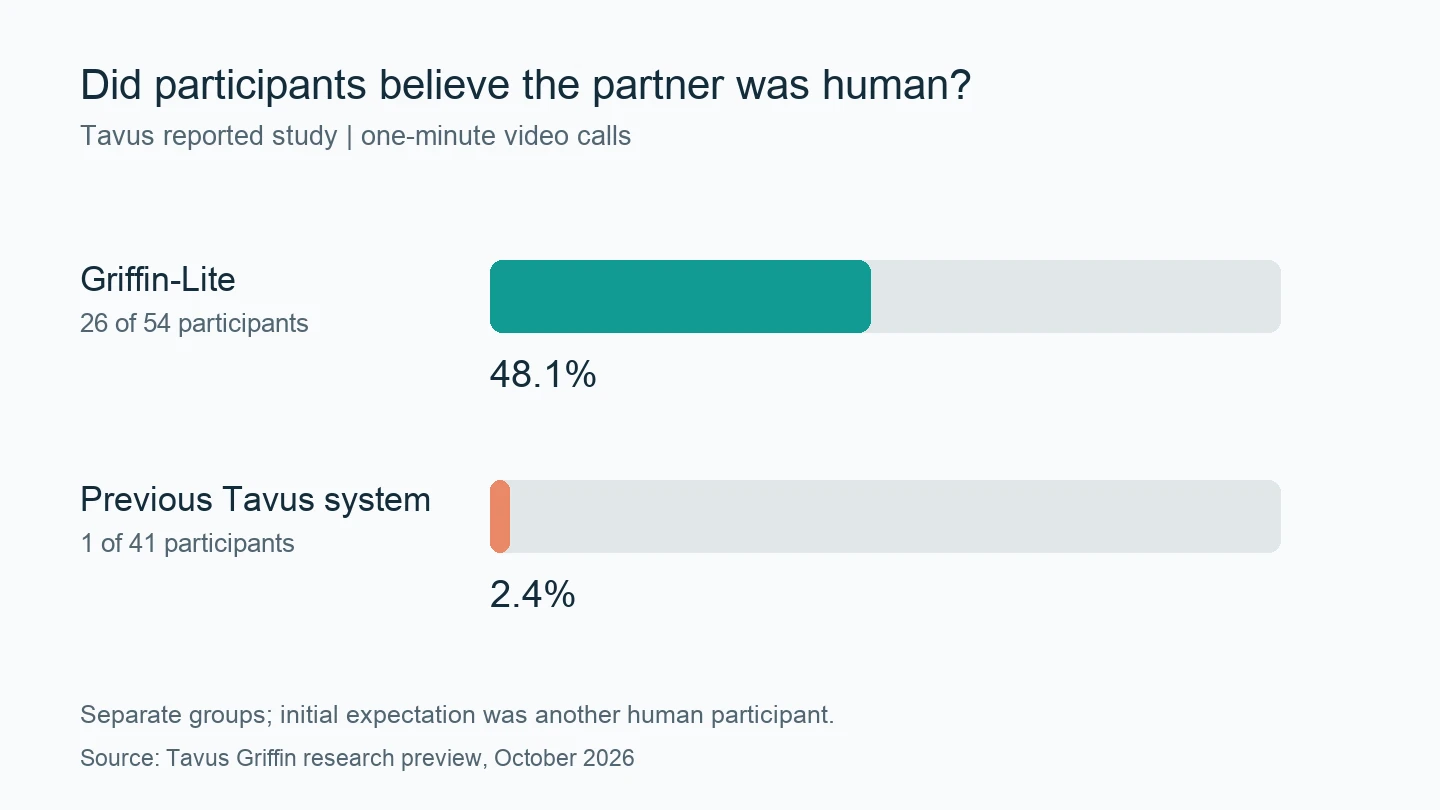
That is an interesting result for a brief conversational setting. It does not establish that 48% of all people would be fooled in any situation, that the model could pass a long interview, or that every viewer would find its face convincing. Participants were initially told they would meet another participant, so this also differs from deliberately challenging people to spot AI from the start.
“First to pass” is Tavus's characterization of its result, rather than a universal certification. For someone choosing a tool, natural timing, useful answers, and consistent behavior during their own task are more practical questions than the headline alone.
Which Griffin demos are worth watching?
The official Griffin demo collection demonstrates several distinct interaction behaviors:
- Simon Says: the system listens for an instruction, observes hand movements, and produces gestures. This illustrates simultaneous audio and visual interaction.
- A story interrupted by an object: a participant holds up a peacock, which becomes part of the story. This illustrates visual context affecting an ongoing response.
- Rubik's cube coaching: Griffin responds to what it sees in the participant's hands and waits during a thinking pause. This illustrates observation and conversational timing.
- A promotion conversation: voice, expression, and gestures respond together to good news. This illustrates coordinated expressive behavior.
These are Tavus demonstrations, not our own tests. When watching, pay attention to when a reaction happens and whether it fits the conversation, alongside lip sync and appearance.
Can you try Tavus Griffin AI today?
As of October 2, 2026, Griffin is not on the public Tavus platform. Tavus says Griffin-Lite is available to selected trusted testers and points interested testers toward an access-request form in the research preview's availability section. A wider release is planned, but the announcement gives no fixed date or public Griffin price.
For now, the official demos are the clearest way to explore the announced capability. Tavus also offers its existing PAL Maker, which its Griffin page describes as using the earlier video-interaction models. Access to an existing Tavus product should not be mistaken for access to Griffin.
What can you create while following Griffin's release?
If your goal is a finished visual rather than a live conversation, you can start with a character portrait in MagicCreator's AI image generator, then explore image-to-video creation for a short character scene or social clip. Give the prompt a clear subject, action, setting, and camera direction, and choose an available model that supports your task.
MagicCreator does not currently offer Griffin or its real-time video-call experience. These creation tools serve a different result: images and recorded clips you can review and share.
Quick answers about Griffin AI
Who made Griffin AI?
Tavus developed Griffin. In this article, Griffin AI refers to Tavus's Human Interaction Model and its Griffin-Lite research preview.
Is Griffin an LLM or a video model?
Tavus describes it as a video-to-video interaction system combining continuous conversational modeling with streaming speech and video generation. Its intended output is a responsive audiovisual conversation, rather than only text or a finished movie.
Is there a free Griffin AI demo?
Official demonstration videos are available to watch. The announcement does not offer unrestricted public Griffin access or announce a free consumer tier.
Does Griffin passing the video Turing test mean it is human-level AI?
The reported result concerns perceived humanness after one-minute calls under a particular study protocol. It does not establish human-level ability across tasks or conversations.