
Wan 3.0 and Seedance 2.5 both target long, reference-guided AI video with native audio, but they fit different workflows. Wan 3.0 has the clearer official path for 1080p output, first-and-last-frame control, and turning a file or public webpage into a video brief. Seedance 2.5 has the larger advertised reference allowance and is already selectable in MagicCreator. Neither is a universal winner, and public specifications alone cannot prove which one makes the better-looking clip.
The practical choice is straightforward: use Seedance 2.5 when you want to create in MagicCreator now or coordinate a large image reference set. Consider Wan 3.0 through a currently supported provider when 1080p, a two-second clip, first-and-last-frame control, or file/webpage input is essential. If visual quality decides the project, run the matched test near the end of this guide before choosing.
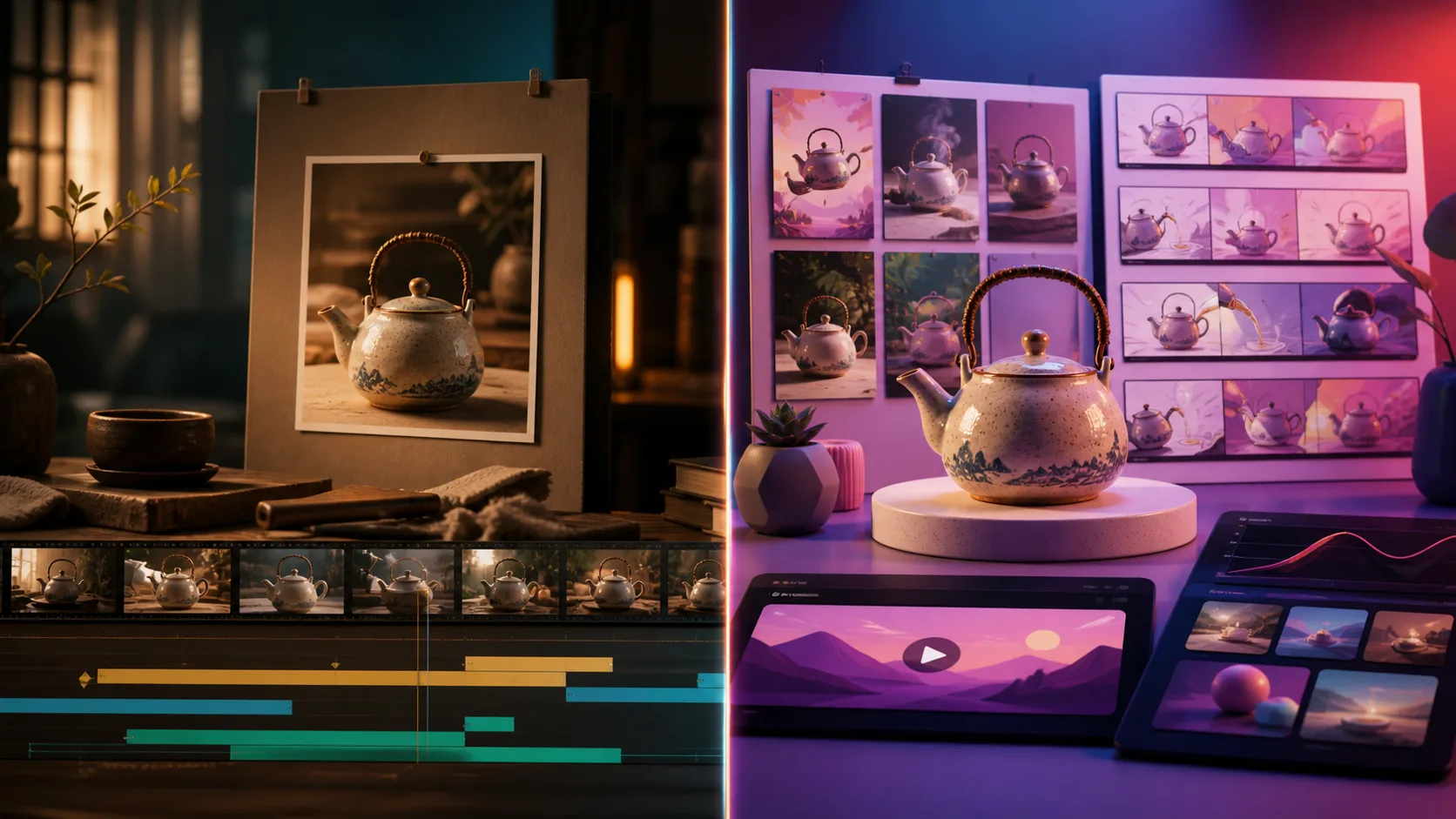
Editorial artwork illustrating two reference-guided video workflows. It is not an output or benchmark from either model.
Wan 3.0 vs Seedance 2.5 at a glance
| Decision point | Wan 3.0 | Seedance 2.5 | What it means for you |
|---|---|---|---|
| Current MagicCreator access | Not integrated; the Wan 3.0 model page currently uses a clearly labeled Wan 2.7 workflow | Available in the AI video generator | Choose Seedance 2.5 if you need to create here today |
| Output duration | 2–30 seconds, plus smart duration | 4–30 seconds, plus automatic duration in the current fal endpoint | Both cover a 30-second story; Wan supports shorter two- and three-second shots |
| Resolution | 480p, 720p, or 1080p in Alibaba Cloud's official guide | 480p or 720p in MagicCreator's current fal-backed integration | Wan has the verified 1080p option; Seedance is currently capped at 720p here |
| Reference inputs | Up to 10 images, 5 videos, and 5 audio clips, with 20 multimodal assets total | Provider advertises up to 50 multimodal references; MagicCreator currently exposes up to 30 images | Check the interface you will actually use, not only the model headline |
| Special inputs | First frame, first and last frames, a supported file, or one public webpage link | Text, image, and multimodal reference modes through separate hosted endpoints | Wan is the stronger specification fit for endpoint-controlled frames or brief-to-video work |
| Native audio | Dialogue, background music, and sound effects | Synchronized audio can be generated with the video | Both can reduce a separate sound-design step |
| Editing and extension | Officially documented in the all-in-one model | Listed on the hosted reference-to-video endpoint, but not exposed in MagicCreator's shared form | Availability depends on the product interface as much as the underlying model |
| Pricing in MagicCreator | Not set because Wan 3.0 is not integrated | Calculated from duration, resolution, and aspect ratio | Only Seedance has a real, selectable MagicCreator price today |
This comparison uses Alibaba Cloud's Wan 3.0 documentation, the live fal Seedance 2.5 endpoint schemas used by MagicCreator, and the project's current configuration, checked September 3, 2026. Claims from a model vendor or host describe that source's offering; they are not independent quality results.
Which model fits a 30-second story?
Both models can generate up to 30 seconds in one request, so the headline limit does not separate them. What matters is how you direct the sequence.
Wan 3.0's official guide supports timestamped multi-shot prompts, smart duration, first-frame control, and first-and-last-frame control. That combination is useful when you already know the opening image and need the scene to land on a specific final composition—for example, a closed gift box opening into a birthday reveal, or a product starting in packaging and ending in use.
Seedance 2.5 also supports automatic duration and up to 30 seconds through MagicCreator's current provider. Its practical advantage is immediate access: you can select the model, choose 4–30 seconds, add references, and generate without waiting for a Wan 3.0 integration. For a travel recap, a short product story, or a social narrative you need to finish now, that availability is more important than a specification you cannot yet select.
For either model, split a longer prompt into stages with visible handoff states. Give each stage one main event, then state where the subject, camera, and important props must end. This makes a 30-second request easier to evaluate than a paragraph filled with unrelated actions.
Which model handles reference-heavy projects better?
Seedance 2.5 has the larger advertised ceiling: fal's reference-to-video endpoint describes up to 50 combined image, video, audio, and style references. MagicCreator intentionally exposes a smaller, usable subset—up to 30 reference images—because its common video form does not yet accept Seedance reference video or audio files.
Wan 3.0 officially allows up to 20 multimodal materials in one request: as many as 10 images, 5 video clips, and 5 audio clips. The same all-in-one model also accepts one supported document or one publicly accessible webpage link. Those lower but clearly defined limits may be easier to plan around when your brief includes several media types rather than dozens of images.

An illustrative multimodal workflow, not a Wan 3.0 result. Reference limits and accepted file types still depend on the product or provider you use.
More references do not automatically produce a more faithful video. Start with the smallest set that defines the subject, environment, action, and sound. Give every asset one job in the prompt, and add another only when it supplies information the current set does not contain.
Choose Wan 3.0's input approach when
- a first and final frame must anchor the sequence;
- a product page, public webpage, or supported document is the creative brief;
- you need image, video, and audio references within published per-type limits;
- the final delivery specifically requires a verified 1080p option.
Choose Seedance 2.5's input approach when
- the project needs many image references for characters, products, locations, or style;
- up to 30 image references in MagicCreator are enough for the job;
- you want to assign references as
@Image1,@Image2, and so on in the prompt; - you need a model that is already available in MagicCreator.
For detailed reference mapping and scene structure, use the Seedance 2.5 prompt guide.
How do audio and editing compare?
Wan 3.0's official guide says it can create dialogue, background music, and sound effects with the video. It also documents adding, removing, or changing elements; style and lighting changes; dialogue edits; and forward or backward extension from an existing clip. These capabilities sit behind one all-in-one model name, although a provider can still expose only part of the contract.
Seedance 2.5's hosted endpoints also generate synchronized audio. fal lists editing and extension under its reference-to-video endpoint, where a reference clip and prompt describe what to change or continue. MagicCreator currently generates Seedance video with optional native audio but does not expose reference-video editing in its shared form.
For an everyday project, judge the workflow you can operate:
- Dialogue scene: test exact words, lip movement, voice continuity, and whether music competes with speech.
- Product clip: test whether shape, markings, and color survive motion before comparing cinematic style.
- Extension: check the first frame of the extension against the last frame of the original, then listen for an audio seam.
- Targeted edit: confirm that requested changes happen without shifting faces, props, framing, or timing elsewhere.
The published feature list tells you what to try. Only the resulting clip tells you whether the feature works well enough for your material.
What does each model cost?
There is no honest single price comparison across all products. Alibaba Cloud, fal, and other hosts can use different units, regions, modes, and rate limits. A per-second number from one host is not directly comparable with a subscription credit from another.
MagicCreator has no Wan 3.0 credit price because the model is not integrated. The Wan page does not charge Wan 3.0 credits or imply that its current Wan 2.7 generator is the new endpoint.
Seedance 2.5 is live in MagicCreator and uses token-based provider pricing converted into credits. At the current 16:9 settings, a 720p generation is estimated at 47 credits for 5 seconds and 278 credits for 30 seconds. Automatic aspect ratio and image-led frame mode can cost more because the estimate must cover larger output dimensions. The generator shows the current credit total before you submit.
Compare the cost of a usable result, not one attempt. Record the first generation, retries, reference preparation, editing, upscaling, and any external audio work. A model with a higher displayed generation cost can still be cheaper if it needs fewer reruns; that can only be measured with your own matched task.
A fair Wan 3.0 vs Seedance 2.5 test
No paired MagicCreator benchmark is presented here because Wan 3.0 is not yet integrated. When both models are available through interfaces that expose equivalent controls, use this repeatable test instead of comparing unrelated showcase clips.
Test brief
Create a 10-second, 16:9 product story at the same available resolution. Use one clean product image and the same prompt:
A speckled ceramic teapot sits on a walnut table in soft morning light.
Begin with a medium front view. The lid lifts slightly as steam rises, then
the camera makes one slow clockwise arc while a cup slides into frame.
End with the teapot and cup centered and fully visible. Preserve the exact
shape, handle, spout, glaze pattern, and color from the reference image.
Use quiet room ambience and a gentle ceramic clink. No text or subtitles.
Generate at least three clips per model. Keep duration, aspect ratio, resolution, audio setting, source image, and prompt unchanged. If the two interfaces cannot match a setting, record the difference instead of silently treating the outputs as equivalent.
Review the same observable outcomes
| Check | What to inspect |
|---|---|
| Product identity | Handle, spout, lid, glaze pattern, color, and proportions remain consistent |
| Prompt completion | Steam, lid motion, cup entrance, camera arc, and final composition all occur |
| Motion | Objects move without bending, duplication, sudden jumps, or unwanted camera changes |
| Audio | Ambience and clink match the visible timing without distracting speech or music |
| Repeatability | The required actions succeed across the set, not only in the best clip |
| Finished cost | Total cost includes failed attempts and any extra repair or editing steps |
Keep every output, including failures. A cherry-picked winner answers which single clip looked best; the full set answers which model is more dependable for your task.
Final choice: Wan 3.0 or Seedance 2.5?
Choose Seedance 2.5 in MagicCreator today when access, a long 4–30 second scene, native audio, or a large image reference set matters most. You can start in the AI video generator, see the available controls, and know the credit estimate before submitting.
Choose Wan 3.0 through a verified current provider when your project specifically needs its documented 1080p output, 2–3 second duration, first-and-last-frame control, file or webpage input, or the all-in-one editing workflow. MagicCreator's Wan 3.0 model page explains the model and clearly marks the current Wan 2.7 fallback while Wan 3.0 integration remains pending.
If neither set of workflow differences settles the decision, do not choose from marketing language. Run the matched test with your actual subject, score only visible and audible outcomes, and include retries in the final cost.
Frequently asked questions
Is Wan 3.0 better than Seedance 2.5?
There is no verified universal winner. Wan 3.0 has documented advantages for 1080p, very short clips, first-and-last-frame control, and file or webpage input. Seedance 2.5 has a larger advertised reference allowance and is available in MagicCreator now. Output quality should be compared with the same prompt, inputs, and settings.
Can both models make 30-second video with audio?
Yes. Wan 3.0's official guide supports 2–30 second output with native dialogue, music, and effects. The current Seedance 2.5 hosted endpoint supports 4–30 seconds with optional synchronized audio.
Which model supports more references?
Seedance 2.5's fal endpoint advertises up to 50 multimodal references, while Wan 3.0 officially supports up to 20 multimodal materials with per-type limits. MagicCreator currently exposes up to 30 images for Seedance 2.5, not the full hosted multimodal set.
Can I use Wan 3.0 in MagicCreator?
Not yet. Wan 3.0 is generally available through Alibaba Cloud, but MagicCreator has not integrated its endpoint. The current generator on the Wan 3.0 page is labeled Wan 2.7.
Can I use Seedance 2.5 in MagicCreator?
Yes. Seedance 2.5 is selectable for text-to-video, image-to-video, and reference-image workflows, with 480p or 720p output, 4–30 second duration, and optional native audio.
Which model is cheaper?
The answer depends on provider, settings, and retries. MagicCreator currently prices Seedance 2.5 but has no Wan 3.0 price because Wan 3.0 is not integrated. Compare the same duration, resolution, aspect ratio, audio choice, and total attempts before deciding.
Sources and update notes
Last fact check: September 3, 2026. This article will be updated at the same URL when MagicCreator integrates Wan 3.0 or when matched outputs are available.
- Alibaba Cloud Wan 3.0 generation guide — official tasks, inputs, limits, duration, resolution, audio, editing, and extension.
- Alibaba Cloud newly released models — Wan 3.0 model IDs and release timeline.
- fal Seedance 2.5 text-to-video — hosted endpoint schema, duration, resolution, audio, and pricing method.
- fal Seedance 2.5 reference-to-video — hosted multimodal reference, editing, and extension contract.